Showing posts with label wearables. Show all posts

Wednesday, August 19, 2020

When Technology Hits Muscles

[Originally written on 2020-04-29]
We have recently built out our home gym to include a NordicTrack S22i studio cycle and a NordicTrack X22i treadmill.  Both of them have large screens (~ 22") that are running an old version of Android to run the interface, including the iFit Cardio app that was preloaded onto them.

So far, here are our issues with the S22i:
- 2020-04-26: When connecting the HDMI cable, a (non-bike) workout will stop showing the video after about 4 minutes.  You'll still hear the sound, but the video goes away.  If you run a workout like this without the HDMI cable, it will continue without interruption.
- 2020-04-29: My wife was 58 minutes into a cycling workout and the app just shut down.  After returning to the app, it had lost its place and she couldn't return to her workout successfully.

[Addendum]
Ultimately, I decided to skip the S22i or the treadmill for feeding video into the TV.  After first trying a Google Chromecast, I have settled on an Amazon Fire Stick.  The Chromecast required a device (my wife's iPad) to connect to BeachBody first and then connect to the Chromecast.  She experienced frequent buffering issues and other problems.  I just installed the Fire Stick, but it works well with Beachbody and Plex (for dancing DVDs, though Esther has to verify that the chapter markers were put at useful places).

My next challenge is to side load iFit, so Esther can do non-machine based workouts on the TV and not rely on the smaller screens of the bike or the treadmill.  I'm guessing she won't do that terribly frequently because she's been loving the BeachBody options, but I'd like to have it there in any event.

[Addendum #2, 2020-11-25]
Our gym is pretty much complete, we even have encouraging messages (via vinyl decals) on the walls.  A few notes on how the technology has developed in the gym:
  • I noticed (likely after a spin workout on the S22i) that there was a cable and ethernet jack in the gym alongside the bike.  I decided to find that cable in the network room and was fortunate that I could.  I did have to terminate the cable on the network side, but it wasn't hard.  After that, I hooked up a PoE injector and plugged it into my 24 port switch.  In the gym, I plugged in an ethernet cable, ran it along the outside of the room and installed what had been my outdoor WiFi access point (Ubiquiti).  It is only 2.4 GHz, but from what I could tell, so were the bike and the treadmill (I'm pretty sure the Firestick, as well).
  • The NordicTrack devices are working much much better.  We now almost never have any unexplained shutdowns or workout restarts.  
  • Running Beachbody on the Firestick has worked really well.  While there is some initial buffering, there is almost never a lag in the workout itself.
  • iFit does not have a native FireStick app, as noted above, and sideloading was not successful.  I got it on there, but in the end, I couldn't get it past the screen requiring you to accept the health risks of the device.  Frustrating, but not unexpected due to the apparent crappy software skills of this company.

Overall, I'm pretty happy with how our setup has turned out.  A couple of pics:


Sunday, January 20, 2019

What Tech I Want, I Think (Early 2019)

It has been a while since I've written about a list of current tech items that have caught my eye.  I thought that it might make sense to given that CES 2019 just ended.

What I Want:


  1. Humon Hex: it tracks oxygen availability in your muscles (specifically your thigh).  It provides more direct feedback on how hard you are working (which I'd always wanted to know).  Maybe I'm being lazy or just feel tired when my body is capable of doing more - this gives you a much better sense of how true that is.  Cost: ~$300.  Availability: Immediate.
  2. Garmin Vector 3 Power Meter: I have gotten used to having legit power meter information from the Stages spin bikes at the Equinox at which I am a member.  Going for outdoor rides now are not as information rich.  I much prefer the outdoor ride (in the right weather), and already have speed and cadence sensors, so this is the next step.  It's a lot of money, though.  Cost: ~ $900.  Availability: Immediate.
  3. K'Watch Glucose: A continuous glucose monitoring watch.  It requires a consumable which needs to be replaced every 7 days, but it looks super cool.  I'd love to wear for a couple of months to see how my activities, eating, drinking, working out and all affect my blood sugar levels.  I feel like I'd learn a lot over the first month or two of wearing it.  Maybe not too much after that.  Cost: ~ $150 for the watch, $100/month for the consumable. Availability: Unknown, but hopefully in 2019.
  4. LIDAR Lite v3HP: A small 40m range LIDAR from Garmin.  I would love to work this into a Raspberry Pi 3 project to build a small device that would measure speeds on the road in front of me and then post the fastest on a website along with vehicle pictures (with ALPR, ideally) and a graph of the distribution of the speed of cars on the road.  Maybe someday I'll get to this project.  Cost: $150.  Availability: Immediate.
  5. Naked Labs Body Scanner: I know I drink too much beer to keep my gut in check, but I think it would be super cool to get a long term view of where fat is being added and removed as you move through time.  So you should have a much better view of the aggregate body fat, and also the view of where it's coming and going from.  Also, you get your weight.  Cost: $1495.  Availability: Q219, I believe.
  6. Air Quality Monitor: I'm not sure that Awair is the one, but I would like something that tracked indoor air quality that was inexpensive enough that I could have several of them in my house.
  7. A compact point and shoot camera: a successor to my Canon S100.  Not sure what's best out there now, nor what the right amount of money is.  Sometimes, the camera on my phone just doesn't capture the magic.

What I Don't Want

  1. MagicLeap AR Eyeglasses: Not until somebody shows me software that matters.  Cost: $2295.
  2. 8K TV: Not until most content is 8k.  I bought my current 65" Sharp LCD 1080p TV in 2008.  It's still pretty great.  When it fails, I will buy a 4k TV of similar size (we'll see about OLED).  In fact, I'm rather hopeful that the Samsung modular micro-LED approach gathers some steam and we get some cool options there.
  3. Bike head's-up glasses: Way too much money.  Way too early in the product maturation cycle.  Same for a motorcycle helmet head's up display.
  4. USB turn-table: Maybe a cool mix of old and new, but I'm not a vinyl guy.  Spotify for me, right now.
  5. Glowing alarm clock: My Garmin Forerunner 935 vibrating works just fine.  I wake up at a different time than my wife, so I think that lighting the whole room up would be disruptive.
  6. Any voice-activated appliance: I have an Echo Show and I like it.  I just don't feel the need for a microwave that has this built in.
  7. Any robot: call me when they are actually useful for more than vacuuming.
  8. HTC Vive Pro Eye: but only because I don't have the space to devote to it right now.  Also, having bought the original Vive, I feel like there isn't enough software for it.
If I think of anything more, I'll add to the list.

Wednesday, October 1, 2014

The State of the Art in Smart Watches


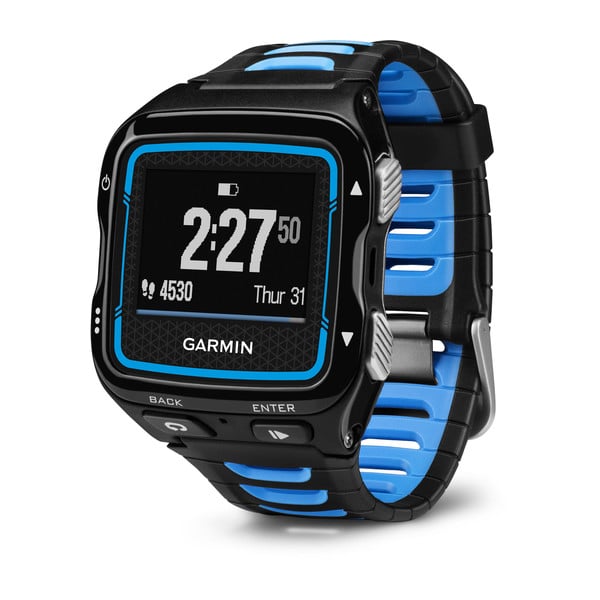
Apple's smart watch isn't nearly as smart as this guy, the Garmin Forerunner 920XT.  I can't wait, despite the fact that it'll cost ~$500 with the HRM-Run heart rate monitor.

I've owned a Forerunner 405 for about six years and I've enjoyed having access to the data from both running and biking.  The 920XT takes things up a notch and if I bought one, I could see myself never wanting to take it off.  From the 405, it steps things up by adding:

  • Activity tracking (good bye fitbit?)
  • Running form (when used with HRM-Run monitor)
  • Swimming!  Laps and cadence and stroke
  • Color display: seems nice but not necessary
  • Smart phone integration (will show a text).  Not sure that I care about this.  Often, I'm running with my watch to avoid having to lug my phone around.  But who knows.
  • Battery life: claimed 24 hours in normal mode.
  • Power-meter compatible (though I don't see myself dropping $1500 on pedals)

Much of this look genuinely useful.  Now, this is only based on what they say it'll do.  Who knows.  But I would love to find out.  Maybe this'll have to be my Christmas present to myself.

Sunday, July 6, 2014

Maybe not all Wearables Make Sense

Or perhaps this post should be titled, Wearables for the Masochistic.  I don't see myself ever wanting to wear one of the new wristbands that will give you a mild electrical shock you when you don't do enough exercise, as this MailOnline article describes.  It is called Pavlok and it looks much like a FitBit Flex.


Certainly, there is going to be a raft of creativity applied to wearables over the next months and years.  Let's hope that results in useful, meaningful advances rather than more like this.

Wearables are Here to Stay (at Work)

So I rarely look at anything on Google+.  But as I was finishing up making a bunch of blog postings this morning, I happened to look at what is there.  I noted that Google is really pushing their Glass product through a gazillion posts.  One of their posts stuck out to me and I had to watch the YouTube video associated with it.

I've argued with my son about whether Google Glass will survive.  Andrew is quite convinced that it will not.  I think that it will and it will come through to general society after people are used to using them and seeing them in a work environment.  The video that I watched only served to harden my opinion on the matter.

This is the video:


The company, Wearable Intelligence, is planning on giving things a go in healthcare and the oil & gas production industry. Both, I believe are ripe for material productivity enhancements and I can see after some well publicized cost cutting, many other companies will be very interested in their use.

And this is how it will begin.  People will get used to wearing these things at work or seeing them on other people who they are working with (or shopping at their store, etc.).  It will be hard to escape them at some point.  Then, I think it will become more commonplace to see normal people wearing them and doing so for good reasons (usefulness in their daily lives).

But then again, perhaps we will always think of these items as the bluetooth earpiece that clowns will leave in their ear despite not being on a phone call, but still brandishing the large blue light.  I still think that Glass or something like it, will be with us for a long time (and not just in specialty applications).

Thursday, March 6, 2014

When Will Wearables Explode?

Not thinking in the literal sense, but in something more than the industry hype sense.  I hope that the hype has peaked and we are moving into the period of hard work where people make products attractive and usable for the masses, not just the early adopters.

Here are some ill-informed views on when I think that wearables will really take off:

  • When "energy harvesting" is built-in from the start.  While I am generally not too annoyed that I have to charge my fitbit once per week, I'd rather I didn't have to.  It seems somewhat ironic, as well, that a device that is capturing my motion data, is not using that motion to its benefit.  How cool would it be if I never had to charge my fitbit (as long as I used it)?
  • Data transmission is standardized.  Good example: I have a fitbit and a Garmin ForeRunner 450.  Both require proprietary USB adapters to connect to my computer.  Hopefully, devices will coalesce around using low power BlueTooth or some single suitable technology.  Better than this, it'd be great if the devices didn't use near-field technology at all, but instead connected to Wifi and take the computer out of the equation.
  • More complete monitoring.  Steps are a good first step.  But not nearly enough for a compelling fitness / wellness view.  
    • How about:
      • 3D movement, interpreted, so that you don't have to log what activity you were doing.  Premium systems could include multiple sensors for a better read (wrist, hip & ankle).
      • Heart rate (and better yet actual ECG signal)
      • Blood oxygen levels
      • Respiratory rate
      • Perspiration levels
      • Blood pressure
      • GPS location, even if only through your phone
    • Some of this should be real-time, but where that gets hard, at least make near real time (like Azoi could be used right after getting off the treadmill).
  • Some better understanding of how people want to change themselves (or remain the same).  
    • For instance, is it important to you to:
      • Train for a particular event
      • Just get "better"
      • Remain at your current high fitness level
    • Provide real feedback tailored to such.  I'm afraid that this will remain in the "paid extra" category, but I don't think that it will take off until a subscription is not required.  I'd be much more willing to buy a premium version of the product up front that has this built into the cost rather than a subscription and think that many others share my aversion.  It boggles my mind that this isn't being done already with fitbit.
  • Capture "uncapturable" information and integrate it into your product.  
    • AskMeEvery is a great example of how this could be done:
      • Wearable user works out
      • Wearable system asks user how fatigued they are after the workout (via email, if necessary)
      • Wearable system determines that its pretty much the same workout as they had done three days ago
      • Wearable system alerts user that they are making progress: their reported fatigue is only 8 out of 10 instead of the 10 out of 10 they reported three days ago
    • To be fair, fitbit and others are doing this with food.  But it comes in the "paid extra" category and still isn't easy enough to do reliably.
  • Generally decrease the uncapturable information in the system.  A few thoughts:
    • Build a kitchen scale with wifi that can be used in conjunction with a phone app.  Have people weigh their food.  (Seems like this could already exist and I'm just unawares).  It has to be much more accurate that taking a picture or just estimating.  And easier.  I had 18oz of lasagna.  Done.
    • [Other ideas to be added as they (hopefully) come to me.]